Features
Name:
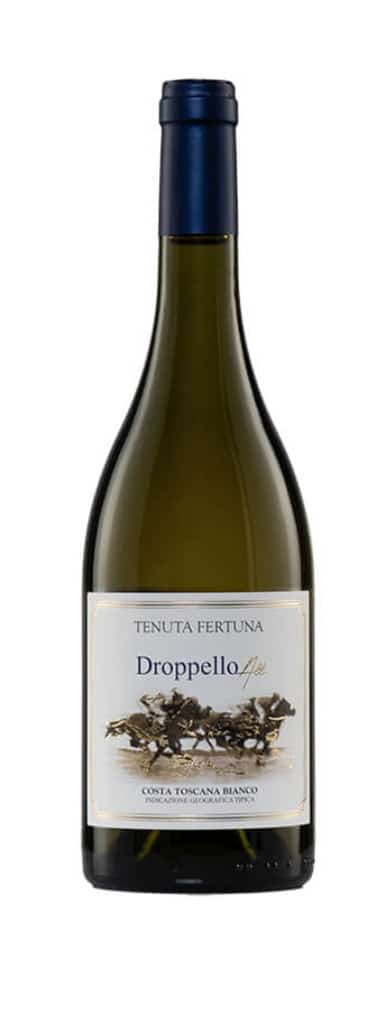
Droppello Alto Toscana White IGT 2022
Terrain:
Galestro (schist rock) and Alberese (limestone substrate)
Cellar
Tenuta Fertuna was established in 1997 in the heart of the Tuscan Maremma. Fertuna, whose name refers to the fertility of the land and the good fortune of the men who cultivate it. The estate was born on a land extremely devoted to viticulture, in a place where the dominant note is nature; amidst the wild and spontaneous vegetation, the hand of man has acted with delicate harmony, designing an amphitheatre of vineyards. Soils rich in Galestro (schist rock) and Alberese (calcareous substrate), good day/night temperature range, make the Maremma a terroir particularly suited to vine cultivation. The estate covers 145 hectares, 50 of which are currently under vine. Functionality and hyper-technology, combined with a project of high environmental sustainability, are the guidelines of the winery, built at the base of the vineyards. After years of conventional farming, they decided in 2016 to convert production to organic and rediscover a sense of the environment of the natural.
Description
The ultimate expression of still white wine made from red grapes, it interprets the soul of Sangiovese in a completely modern and original way. It comes from a single plot, 'Alborelli',
a unique interpretation ennobled by a long stay on natural yeasts and ageing in wood. The setting in which the vineyards are cultivated is the Antica via Aurelia, between the Gulf of Follonica, Castiglion della Pescaia and Punta Ala.
Organoleptic characteristics:
Intense straw yellow colour. Mineral notes, intense fruity and floral tones, fresh citrus nuances. Persistent and elegantly velvety, a wine to be enjoyed in its enthralling breadth. It wants to be the evolutionary step of what was the pioneering experimentation of white vinification of Sangiovese grapes and the achievement of the goal of a totally organic production.
Storage time:
2-4 years
Vinification
The must obtained is slightly oxidised and rests at low temperature in steel for a few days to amplify the aromatic extraction. Fermentation at a low
temperature with a selected blend of indigenous yeasts. Evolution for 12 months on "fine lees". This is followed by ageing for 6 months in new tonneaux
of Allier; in wood, various bâtonnage operations follow, giving the wine complexity and intensity
Acknowledgements
2021 Veronelli 87/100